
NASA had been pursuing spaceplane development since the 1960s, blending the administration’s dual aeronautics and space missions. NASA viewed a spaceplane as part of a larger program, providing routine and economical logistical support to a space station in Earth orbit that would be used as a hub for lunar and Mars missions. A reusable launch vehicle would then have ended the need for expensive and expendable boosters like the Saturn V.[4]
In 1969, NASA designated the Johnson Space Center as the lead center for the design, development, and manufacturing of the Space Shuttle orbiter, while the Marshall Space Flight Center would lead the development of the launch system. NASA’s series of lifting body aircraft, culminating in the joint NASA-US Air Force Martin Marietta X-24, directly informed the development of the Space Shuttle and future hypersonic flight aircraft. Official development of the Space Shuttle began in 1972, with Rockwell International contracted to design the orbiter and engines, Martin Marietta for the external fuel tank, and Morton Thiokol for the solid rocket boosters.[31] NASA acquired six orbiters: the Enterprise, Columbia, Challenger, Discovery, Atlantis, and Endeavour.[4]
The Space Shuttle program also allowed NASA to make major changes to its Astronaut Corps. While almost all previous astronauts were Air Force or Naval test pilots, the Space Shuttle allowed NASA to begin recruiting more non-military scientific and technical experts. A prime example is Sally Ride, who became the first American woman to fly in space on STS-7. This new astronaut selection process also allowed NASA to accept exchange astronauts from US allies and partners for the first time.[4]
The first Space Shuttle flight occurred in 1981, when the Columbia launched on the STS-1 mission, designed to serve as a flight test for the new spaceplane.[32] NASA intended for the Space Shuttle to replace expendable launch systems like the Air Force’s Atlas, Delta, and Titan and the European Space Agency’s Ariane. The Space Shuttle’s Spacelab payload, developed by the European Space Agency, increased the scientific capabilities of shuttle missions over anything NASA was able to previously accomplish.[4]
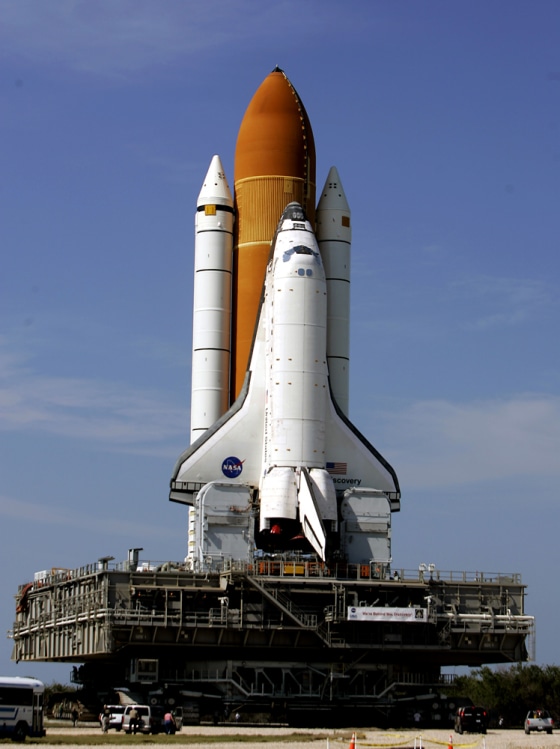
Space Shuttle Discovery in Low Earth Orbit on STS-120
NASA launched its first commercial satellites on the STS-5 mission and in 1984, the STS-41-C mission conducted the world’s first on-orbit satellite servicing mission when the Challenger captured and repaired the malfunctioning Solar Maximum Mission satellite. It also had the capability to return malfunctioning satellite to Earth, like it did with the Palapa B2 and Westar 6 satellites. Once returned to Earth, the satellites were repaired and relaunched.[4]
Despite ushering in a new era of spaceflight, where NASA was contracting launch services to commercial companies, the Space Shuttle was criticized for not being as reusable and cost-effective as advertised. In 1986, Challenger disaster on the STS-51L mission resulted in the loss of the spacecraft and all seven astronauts on launch, grounding the entire space shuttle fleet for 36 months and forced the 44 commercial companies that contracted with NASA to deploy their satellites to return to expendable launch vehicles.[33] When the Space Shuttle returned to flight with the STS-26 mission, it had undergone significant modifications to improve its reliability and safety.[4]
An Air Force Space Command Defense Support Program missile warning spacecraft deploys from the Space Shuttle Atlantis on the STS-44 mission
Following the collapse of the Soviet Union, the Russian Federation and United States initiated the Shuttle-Mir program.[34] The first Russian cosmonaut flew on the STS-60 mission in 1994 and the Discovery rendezvoused, but did not dock with, the Russian Mir in the STS-63 mission. This was followed by Atlantis’s STS-71 mission where it accomplished the initial intended mission for the Space Shuttle, docking with a space station and transferring supplies and personnel. The Shuttle-Mir program would continue until 1998, when a series of orbital accidents on the space station spelled an end to the program.[4]
In 2003, a second space shuttle was destroyed when the Columbia was destroyed upon reentry during the STS-107 mission, resulting in the loss of the spacecraft and all seven astronauts.[35] This accident marked the beginning of the retiring of the Space Shuttle program, with President George W. Bush directing that upon the completion of the ISS, the space shuttle be retired. In 2006, the Space Shuttle returned to flight, conducting several missions to service the Hubble Space Telescope, but was retired following the STS-135 resupply mission to the ISS in 2011.