
Escalations in the Cold War between the US and Soviet Union prompted President John F. Kennedy to charge NASA with landing a man on the Moon and returning him safely to Earth by the end of the 1960s and installed James E. Webb as NASA administrator to achieve this goal.[11] On May 25, 1961, Kennedy openly declared this goal in his “Urgent National Needs” speech to Congress, declaring:
I believe this Nation should commit itself to achieving the goal, before this decade is out, of landing a man on the Moon and returning him safely to Earth. No single space project in this period will be more impressive to mankind, or more important for the long-range exploration of space; and none will be so difficult or expensive to accomplish.
Kennedy gave his “We choose to go to the Moon” speech the next year, on September 12, 1962 at Rice University, where he addressed the nation hoping to reinforce public support for the Apollo program.[12]
Despite attacks on the goal of landing astronauts on the Moon from the former president Dwight Eisenhower and 1964 presidential candidate Barry Goldwater, President Kennedy was able to protect NASA’s growing budget, of which 50% went directly to human spaceflight and it was later estimated that, at its height, 5% of Americans worked on some aspect of the Apollo program.[4]
Launch of the 1969 Apollo 11 mission
Mirroring the Department of Defense’s program management concept using redundant systems in building the first intercontinental ballistic missiles, NASA requested the Air Force assign Major General Samuel C. Phillips to the space agency where he would serve as the director of the Apollo program. Development of the Saturn V rocket was led by Wernher von Braun and his team at the Marshall Space Flight Center, derived from the Army Ballistic Missile Agency’s original Saturn I. The Apollo spacecraft was designed and built by North American Aviation, while the Apollo Lunar Module was designed and built by Grumman.[4]
To develop the spaceflight skills and equipment required for a lunar mission, NASA initiated Project Gemini.[13] Using a modified Air Force Titan II launch vehicle, the Gemini capsule could hold two astronauts for flights of over two weeks. Gemini pioneered the use of fuel cells instead of batteries, and conducted the first American spacewalks and rendezvous operations.
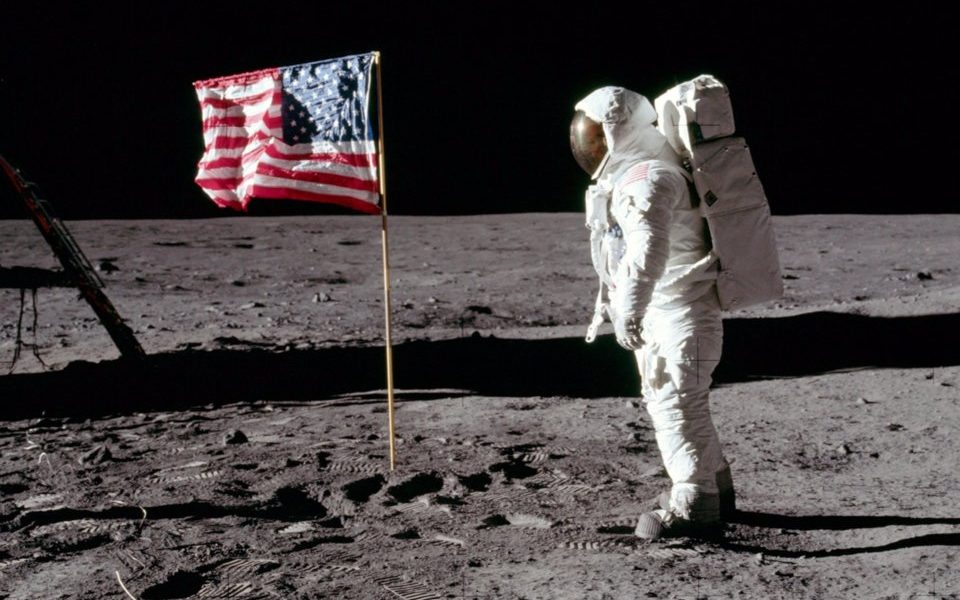
Buzz Aldrin salutes the US flag on the lunar surface
The Ranger Program was started in the 1950s as a response to Soviet lunar exploration, however most missions ended in failure. The Lunar Orbiter program had greater success, mapping the surface in preparation for Apollo landings, conducting meteoroid detection, and measuring radiation levels. The Surveyor program conducted uncrewed lunar landings and takeoffs, as well as taking surface and regolith observations.[4] Despite the setback caused by the Apollo 1 fire, which killed three astronauts, the program proceeded.

Apollo 8 was the first crewed spacecraft to leave low Earth orbit and the first human spaceflight to reach the Moon. The crew orbited the Moon ten times on December 24 and 25, 1968, and then traveled safely back to Earth.[14][15][16] The three Apollo 8 astronauts—Frank Borman, James Lovell, and William Anders—were the first humans to see the Earth as a globe in space, the first to witness an Earthrise, and the first to see and manually photograph the far side of the Moon.
The first lunar landing was conducted by Apollo 11. Commanded by Neil Armstrong with astronauts Buzz Aldrin and Michael Collins, Apollo 11 was one of the most significant missions in NASA’s history, marking the end of the Space Race when the Soviet Union gave up its lunar ambitions. As the first human to step on the surface of the Moon, Neil Armstrong uttered the now famous words:
That’s one small step for [a] man, one giant leap for mankind.
NASA would conduct six total lunar landings as part of the Apollo program, with Apollo 17 concluding the program in 1972.[4]