
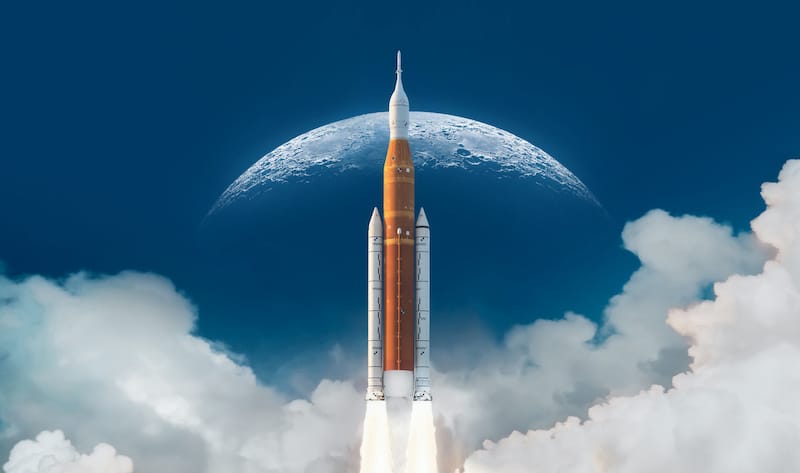
Since 2017, NASA’s crewed spaceflight program has been the Artemis program, which involves the help of US commercial spaceflight companies and international partners such as ESA, JAXA, and Canadian Space Agency.[78] Artemis would be the first step towards the long-term goal of establishing a sustainable presence on the Moon, laying the foundation for companies to build a lunar economy, and eventually sending humans to Mars.
The Orion Crew Exploration Vehicle was held over from the canceled Constellation program for Artemis. Artemis I was the uncrewed initial launch of Space Launch System (SLS) that would also send an Orion spacecraft on a Distant Retrograde Orbit.[79]
The first step toward returning astronauts to the Moon, Artemis II, briefly placed a crew of four into a lunar flyby in April 2026.[80] Artemis III, planned for mid-2027, was originally planned to conduct the first crewed lunar landing since Apollo 17; in February 2026, the mission was changed to a low Earth orbit docking test of Orion. The landing was pushed to Artemis IV, planned for early 2028.[81][82]
In support of the Artemis missions, NASA has been funding private companies to land robotic probes on the lunar surface in a program known as the Commercial Lunar Payload Services. As of March 2022, NASA has awarded contracts for robotic lunar probes to companies such as Intuitive Machines, Firefly Space Systems, and Astrobotic.[83]
On April 16, 2021, NASA announced they had selected the SpaceX Lunar Starship as its Human Landing System. The agency’s Space Launch System rocket will launch four astronauts aboard the Orion spacecraft for their multi-day journey to lunar orbit where they will transfer to SpaceX’s Starship for the final leg of their journey to the surface of the Moon.[84]
Until 2026, NASA additionally planned the construction of the Lunar Gateway, a small space station in lunar orbit designed primarily for non-continuous human habitation.[85] In March 2026, NASA canceled the project in favor of a lunar base.[86]
In 2017, NASA was directed by the congressional NASA Transition Authorization Act of 2017 to get humans to Mars-orbit (or to the Martian surface) by the 2030s.[87][88]